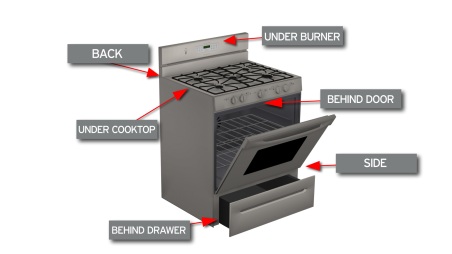
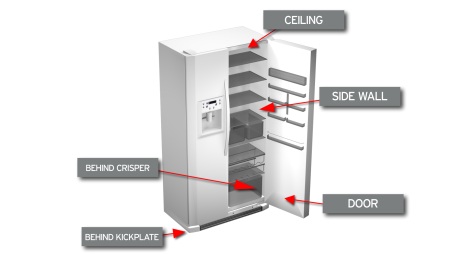
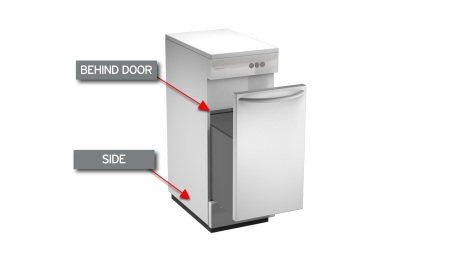
See inside your appliance
Enter the model number of your appliance below to get a breakdown graphic of your appliance.
Locate the model number
on your appliance.
Ready to find your appliance part?
Use our Appliance Part Finder to find the part you need.
Top-Selling Appliance Parts
Why is there a strange noise?
WARNING!
To avoid personal injury or death, disconnect your appliance from its power source
before you start any troubleshooting or repair work. Use caution when working inside any appliance.
Refrigerators with a defrost cycle drain the melted water from
the
evaporator coils through a tube or a hole into a drip pan underneath
the refrigerator. The water usually evaporates, but most times the pan
is removable and can be drained. If this path of water is blocked at
any point because the drain hole or tube is crimped or clotted with
anything, it will back up inside the refrigerator area and try to find
a way out, usually under the crisper drawers. To fix this, clear the
obstruction in the drain tube.
The drain pan at the bottom of the
refrigerator can overflow or get old, crack, and develop a leak. Other
times, mold can grow in the drain tube and clog it.
Most refrigerators have an ice and/or water system built into
them. This means that you have a waterline attached to the back of your
refrigerator and it comes out as ice or cold water. Anywhere that water
travels through the refrigerator and freezer can turn into a leak. To
find the leak, you need to follow the tubes that carry the water
through the appliance and make sure that all connections are tight.
Leaking containers or spills in the refrigerator can be
misdiagnosed as leaks. First make sure that there are no puddles of juice, milk,
water, etc. on one of the large capacity shelves.