$6.99 expedited shipping! Expedited Same Day Shipping on in-stock orders placed by 5 p.m. EST. See Details

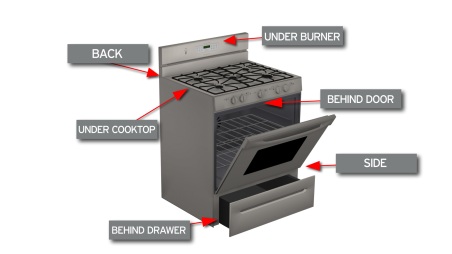
Parts of a gas range

Gas Range graphic

Enter the model number of your appliance below to get a breakdown graphic of your appliance.

Locate the model number on your appliance.

More Gas Range Resources

[Back to Common Questions About Gas Ranges]
[Why should I pre-heat and how important is it?]

When the food is taking way too long to bake, it’s probably a weak bake ignitor. Replacing the ignitor usually fixes this problem, but you probably want to verify that the ignitor is the problem before replacing it.

Sometimes the oven thermostat or oven sensor can be calibrated wrong, or it may be faulty. If your particular range has an oven that uses an electronic thermostat, and the oven temperature is off by tens of degrees, you probably have to replace it.

On most units that have a mechanical thermostat, you can actually remove the thermostat knob, and adjust the knob to more accurately represent the actual setting of the thermostat. On many models, there's a screw on the back of the knob with a small calibration plate or ring. You can loosen this screw and adjust the calibration plate. Remember to tighten the screw again. If yours isn't adjustable, and the temperature is off by a large amount, you should just replace the thermostat.

Check the oven temperature. You can monitor the oven with a calibrating thermometer to check whether or not your thermostat is off. Make sure you pre-heat your oven if the recipe wants you to pre-heat. A couple of minutes cooking at the wrong temperature can mean a world of difference in how baked goods come out.

You also want to check your rack position, and the cooking pan placement on the racks. You want to leave an inch or two between the pan and the walls, and the same amount of space between pans. If you are using two racks, you will want to offset or stagger the pans to allow free air circulation.

A lot of people like to line their oven racks with foil to prevent food spills or drips. Unfortunately, this blocks proper airflow in the oven. If you need to use foil, use it on the rack below the one you're using, and use just enough to catch the drips from that pan. You should never foil the entire rack.

Ovens with convection features in use should be about 25F lower in temperature than the recipe calls for because the convection feature heats foods more evenly.

Another thing to check is the oven vent itself because you don't want anything blocking or covering it. Lastly, make sure the oven is level.

All prices are shown in U.S. dollars. Copyright © 2009 by AP Wagner, Inc. All rights reserved.